
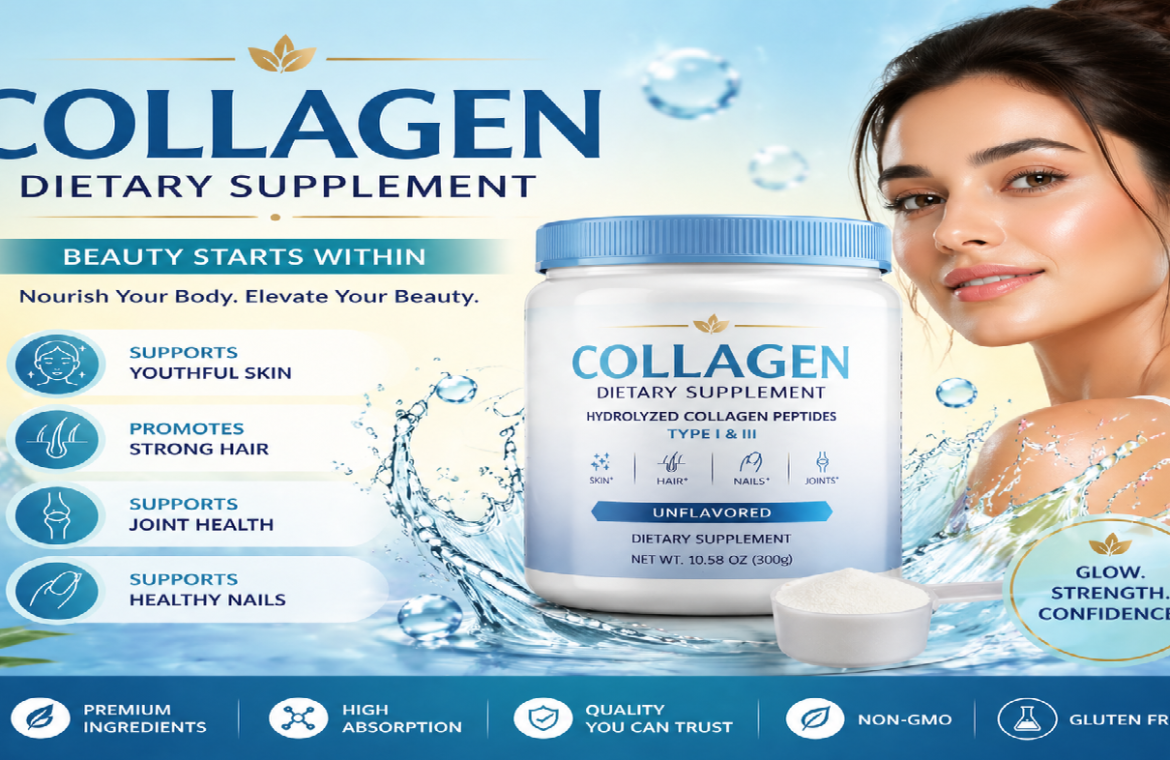
If you’ve been paying attention to the health and wellness space over the past few years, you’ve almost certainly come across collagen dietary supplement products — from flavored powders you stir into your morning coffee to capsules stacked neatly next to the vitamins at your local pharmacy. What was once a niche topic discussed mainly in beauty circles has become one of the most widely used supplement categories in the United States. And for good reason. The science behind collagen supplementation — particularly for anti-aging and joint support — has matured significantly, and the results are worth understanding before you spend your money.
Understanding What Collagen Actually Is
Before diving into the benefits of a collagen dietary supplement, it helps to understand what collagen is and why it matters so much to your body. Collagen is a structural protein — the most abundant one in the human body, in fact — that forms the building blocks of your skin, cartilage, bones, tendons, ligaments, and connective tissues. It gives your skin its firmness and elasticity, cushions your joints, and provides the framework that holds your entire musculoskeletal system together.
The problem is that your body’s natural collagen production starts declining around your mid-to-late 20s, and it doesn’t slow down from there. By the time most people reach their 40s and 50s, they’re producing significantly less collagen than they did in their youth. The visible effects are familiar: skin that loses its bounce, fine lines that become more pronounced, and joints that start to feel stiff or achy after activity. Environmental factors like sun exposure, smoking, and a diet high in sugar can accelerate this decline even further.
A collagen dietary supplement is designed to replenish what the body is no longer making efficiently on its own. Most quality supplements use hydrolyzed collagen — also called collagen peptides — which is collagen that has been broken down into smaller, more bioavailable amino acid chains through a process called enzymatic hydrolysis. These smaller fragments are absorbed through the gut and transported into the bloodstream, where they can reach the tissues that need them most.
The Anti-Aging Case for Collagen Supplements
When most people think about anti-aging, they think about what they put on their skin. But the reality is that lasting skin health starts from within, and that’s where a collagen dietary supplement has its most well-documented effects.
A significant body of clinical research has shown that regular supplementation with hydrolyzed collagen peptides improves key markers of skin aging. Studies have consistently demonstrated improvements in skin elasticity, hydration, and the appearance of fine lines and wrinkles among participants who took collagen supplements daily for eight to twelve weeks. One widely referenced double-blind, placebo-controlled trial published in Skin Pharmacology and Physiology found that women who took collagen peptides daily for eight weeks showed statistically significant improvements in skin elasticity compared to those who took a placebo.
The mechanism behind these results is well understood. When hydrolyzed collagen peptides are absorbed into the bloodstream, they travel to the dermis — the deeper layer of the skin — where they signal fibroblast cells to ramp up their production of new collagen, elastin, and hyaluronic acid. In other words, the supplement doesn’t just add collagen directly to your skin; it prompts your skin to produce more of its own structural proteins. This is what makes the effects cumulative and, for many people, increasingly noticeable over time with consistent use.
Nail and hair benefits are also worth mentioning. Although the research here is less extensive than for skin, several studies have reported improvements in nail brittleness and hair thickness among people taking collagen peptides regularly. The amino acid profile of collagen — particularly its richness in glycine and proline — supports keratin production, which is the primary structural protein in both hair and nails.
Collagen supplementation works from the inside out — prompting your own fibroblasts to produce new collagen, elastin, and hyaluronic acid rather than simply adding a temporary layer on top.
How a Collagen Dietary Supplement Supports Joint Health
Joint health is the other major area where the science behind collagen supplementation is particularly compelling — and for a growing number of Americans dealing with joint pain, whether from aging, athletics, or conditions like osteoarthritis, this is often the primary reason they turn to a collagen dietary supplement in the first place.
Cartilage — the smooth, rubbery tissue that cushions the ends of bones in your joints — is made almost entirely of Type II collagen. As collagen production slows with age and cartilage gradually wears down, joints become less well-cushioned, leading to friction, inflammation, and the pain and stiffness characteristic of conditions like osteoarthritis. Research suggests that taking a collagen dietary supplement may help slow this process and, in some cases, actively support cartilage repair.
A landmark study conducted at Penn State University followed a group of athletes who were given collagen hydrolysate daily for 24 weeks. The researchers found that participants in the collagen group reported significantly less joint pain during activity and at rest compared to those given a placebo. The proposed mechanism is that collagen peptides accumulate in cartilage tissue and stimulate chondrocytes — the cells responsible for producing and maintaining cartilage — to increase their output of new collagen and other cartilage matrix components.
For people with osteoarthritis specifically, a growing number of randomized controlled trials have found meaningful reductions in pain and improvements in physical function among those supplementing with collagen daily. Some rheumatologists and sports medicine physicians have begun recommending collagen peptides as a complementary approach alongside conventional joint treatments, particularly because the side effect profile is minimal compared to long-term NSAID use.
It’s worth noting that for joint-specific benefits, Type II collagen — typically found in chicken-derived supplements or as undenatured Type II collagen (UC-II) — tends to be the most relevant. For those primarily focused on skin, Type I marine collagen offers superior bioavailability. Many broad-spectrum bovine collagen supplements contain a blend of Type I and Type III, which covers both skin and connective tissue support.
Choosing the Right Collagen Dietary Supplement
The US supplement market is vast, and not all collagen products are equal. Here’s what actually matters when you’re choosing a collagen dietary supplement that will deliver results.
Look for hydrolyzed collagen peptides on the label — not simply “collagen protein.” The hydrolyzed form is what the clinical research is based on, and it’s meaningfully better absorbed than whole collagen protein. Many lower-quality products use cheaper collagen sources that haven’t been properly hydrolyzed, which limits how much the body can actually use.
Check the dose. Most studies showing real benefits used between 2.5 grams and 15 grams of hydrolyzed collagen per day. Products with less than 2.5 grams per serving are unlikely to move the needle. For joint support specifically, studies tend to use 10 grams or more. For skin benefits, doses in the 2.5 to 5 gram range have shown positive results in some trials, though higher doses tend to produce more pronounced effects.
Source and quality transparency matter. Look for brands that clearly disclose their collagen source — whether bovine, marine, or chicken — and ideally those that carry third-party testing certifications such as NSF International, Informed Sport, or USP. These certifications mean the product has been independently verified for purity and label accuracy, which is important in a supplement category that isn’t as tightly regulated as pharmaceuticals.
Consider added vitamin C. Vitamin C is a necessary cofactor in collagen synthesis. Without adequate vitamin C, your body can’t efficiently utilize the amino acids from collagen peptides to build new collagen fibers. Many quality formulations include vitamin C in the blend; if yours doesn’t, pairing it with a vitamin C-rich food or supplement is a smart move.
Practical Tips for Getting the Most From Your Supplement
Taking a collagen dietary supplement effectively comes down to consistency, timing, and a few smart habits. First and most importantly, commit to daily use. There is no magic window of time in the day when collagen is more effective — morning, afternoon, or evening all work equally well. What matters is making it a non-negotiable part of your daily routine. Nearly all meaningful clinical trials ran for at least eight weeks, and most people start noticing visible skin improvements in the six-to-twelve-week range.
Collagen peptide powders are easy to incorporate because they dissolve completely in both hot and cold liquids without any gritty texture. Blending into coffee, smoothies, oatmeal, or simply water all work well. The amino acids in hydrolyzed collagen are relatively heat-stable, so cooking applications are generally fine too.
Support your supplement with a diet that includes adequate zinc, copper, and antioxidants — all of which play important roles in collagen metabolism. Foods like leafy greens, berries, citrus fruits, nuts, and lean meats contribute to the nutritional environment your body needs to make the most of what the supplement provides.
Are There Any Risks or Limitations?
For most healthy adults, a collagen dietary supplement is very well tolerated with few if any side effects. Because collagen is simply a protein derived from animal sources, it doesn’t carry the interaction risks associated with many herbal or botanical supplements. Mild digestive discomfort is occasionally reported when starting at higher doses, but this typically resolves within the first week or two.
People with allergies to fish or shellfish should avoid marine-sourced collagen and opt for bovine alternatives. Anyone with kidney disease or a history of kidney stones should consult a doctor before significantly increasing their protein intake through supplementation. And for anyone who is vegan or vegetarian, it’s worth knowing that all commercial hydrolyzed collagen is derived from animal sources — there is no plant-based collagen, only collagen-supporting formulas that supply the precursor nutrients your body needs to produce its own.
The Bottom Line
A collagen dietary supplement is one of the more research-supported options in the crowded wellness supplement market. For anti-aging skin benefits and joint support in particular, the clinical evidence is genuinely compelling — not just anecdotal. When you choose a quality hydrolyzed collagen product, take it consistently at an effective dose, and support it with a nutrient-rich diet, you’re making a well-grounded investment in how you look and how you move as you age.
It’s not a cure-all, and it won’t reverse decades of damage overnight. But as a long-term daily habit — alongside sun protection, an anti-inflammatory diet, and staying active — collagen supplementation is a practical, low-risk strategy that a meaningful body of science now supports. That’s more than you can say for most of what’s on the supplement shelf.