
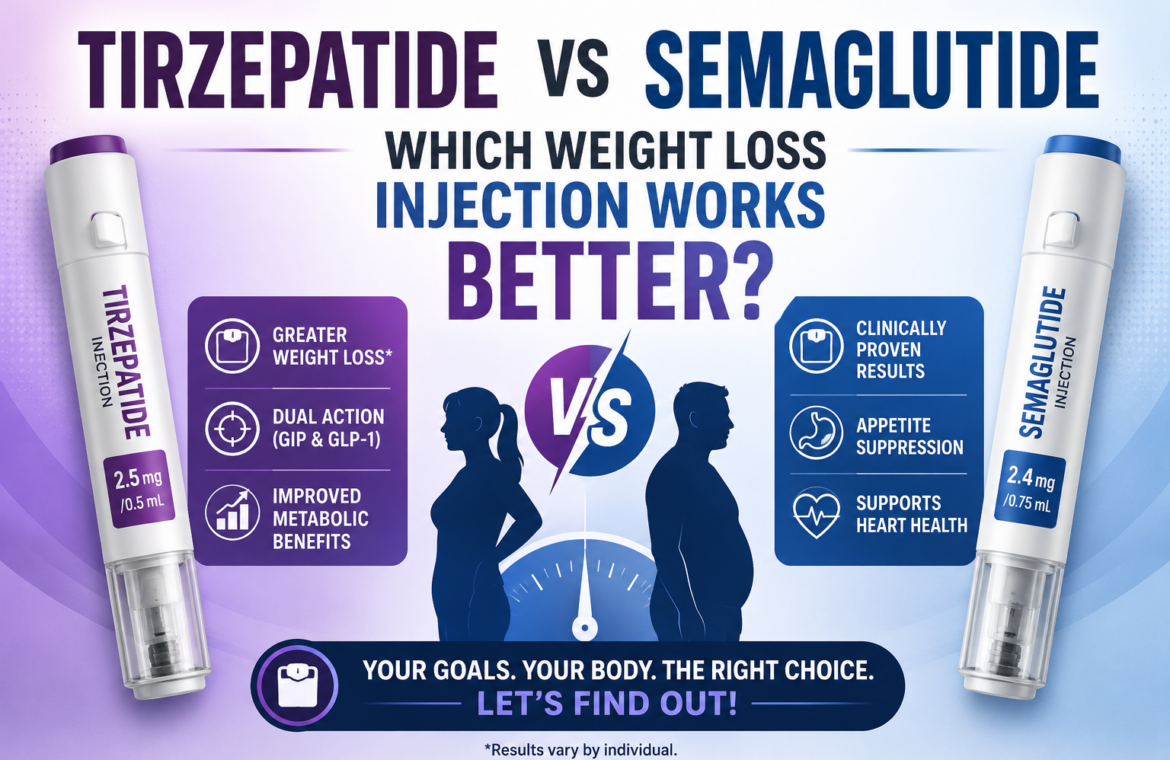
If you’ve been doing any research on weight loss injections lately, two names keep coming up everywhere — Tirzepatide and Semaglutide. Your doctor might have mentioned them. You’ve probably seen them discussed in health forums, news articles, even on social media. And honestly, if you’re someone who has struggled with weight for years, it’s hard not to pay attention when people are reporting significant results.
But here’s the thing — these are two different medications, they work differently in your body, and the results aren’t exactly the same. So when it comes to tirzepatide vs semaglutide, which one actually delivers better outcomes? And more importantly, which one might be right for you?
This article breaks it all down — how each drug works, what the clinical data actually shows, the side effects you need to know about, the cost reality, and what doctors are generally recommending right now. No fluff, no hype. Just a clear picture so you can have an informed conversation with your healthcare provider.
What Are These Medications, Exactly?
Both tirzepatide and semaglutide belong to a class of drugs originally developed to treat type 2 diabetes. They were never intended as weight loss drugs at first — the significant fat reduction was something researchers noticed during diabetes trials, and the pharmaceutical industry ran with it.
Semaglutide is the older of the two. It’s sold under the brand name Ozempic for diabetes management and Wegovy specifically for chronic weight management. Tirzepatide is newer — it’s marketed as Mounjaro for diabetes and Zepbound for weight loss. Both are injectable medications, taken once a week via a small pen-style injector.
The key difference between them is in how they act on your body’s hormone system, and that difference matters a lot when you’re comparing results.
How Each Drug Works: The Science in Plain English
Semaglutide: One Hormone, One Target
Semaglutide is what’s called a GLP-1 receptor agonist. GLP-1 stands for glucagon-like peptide-1, which is a hormone your gut naturally releases after you eat. It signals your pancreas to release insulin, tells your liver to hold back on glucose production, and — importantly for weight loss — it communicates with your brain to reduce appetite and help you feel full sooner.
By mimicking and amplifying this hormone, semaglutide makes you less hungry throughout the day, slows down how quickly your stomach empties, and reduces food cravings. For many people, it’s described as quieting the constant mental chatter about food — what some call “food noise.”
Tirzepatide: Two Hormones, Dual Action
Tirzepatide does something different — and this is where it gets interesting. It’s what’s called a dual GIP/GLP-1 receptor agonist. In addition to activating the GLP-1 pathway like semaglutide does, it also activates the GIP receptor. GIP stands for glucose-dependent insulinotropic polypeptide, another gut hormone involved in insulin secretion and fat storage.
The combination of targeting both receptors appears to produce a more powerful metabolic effect. Your body is essentially getting a signal from two separate hormone pathways at once. This dual action is widely believed to be the reason tirzepatide tends to produce greater weight loss in clinical trials.
Think of it this way — semaglutide turns down the volume on hunger through one channel. Tirzepatide turns it down through two channels simultaneously.
Tirzepatide vs Semaglutide: What the Clinical Trials Show
This is where the comparison gets really meaningful. Both medications have been studied in large, well-designed clinical trials, and the results are worth knowing.
Semaglutide Clinical Results (STEP Trials)
The landmark semaglutide weight loss trial, known as the STEP 1 trial, enrolled over 1,900 adults with obesity who did not have diabetes. Participants taking the highest dose of semaglutide (2.4 mg weekly) achieved an average weight loss of around 14.9% of their body weight over 68 weeks. That’s roughly 33 to 35 pounds for someone starting at 230 pounds.
About one-third of participants lost 20% or more of their starting body weight, which is a number that was essentially unheard of for a non-surgical intervention before these medications came along. The placebo group, by comparison, lost around 2.4% on average.
Tirzepatide Clinical Results (SURMOUNT Trials)
The SURMOUNT-1 trial, which studied tirzepatide in adults with obesity without diabetes, produced even more striking numbers. At the highest dose (15 mg weekly), participants lost an average of 20.9% of their body weight over 72 weeks. About half of participants at that dose lost 20% or more of their body weight, and roughly a third lost over 25%.
These are numbers that genuinely challenge what was previously thought possible outside of bariatric surgery. At lower doses of tirzepatide (5 mg and 10 mg), the average weight loss was still impressive — around 15% and 19.5% respectively.
Head-to-Head Comparison
Direct head-to-head trials between the two medications are limited, but observational studies and meta-analyses have consistently pointed in the same direction. A real-world analysis published in 2023 that tracked over 18,000 patients found that those on tirzepatide lost significantly more weight than those on semaglutide across all time points studied.
Based on the available evidence, tirzepatide appears to produce greater average weight loss than semaglutide, particularly at higher doses. That said, individual responses vary considerably — some people respond exceptionally well to semaglutide, and not everyone tolerates or responds the same way to tirzepatide.
Side Effects: What You’re Likely to Experience
Both medications share a very similar side effect profile since they both work on the GLP-1 pathway. The most commonly reported issues are gastrointestinal.
Common Side Effects (Both Medications)
Nausea is by far the most frequently reported side effect, especially in the early weeks as your dose is being gradually increased. Most people find it manageable and it tends to improve over time. Vomiting, diarrhea, constipation, and stomach discomfort are also reported. Fatigue, particularly early on, is something some patients mention as well.
Both drugs use a slow dose-escalation schedule specifically to minimize these gastrointestinal effects. Starting low and going up gradually over several months gives your body time to adjust.
Serious but Rare Risks
Both medications carry a warning about a potential risk of thyroid C-cell tumors based on animal studies, though this has not been confirmed in human clinical trials. They are not recommended for people with a personal or family history of medullary thyroid carcinoma or a condition called Multiple Endocrine Neoplasia syndrome type 2.
Pancreatitis is another rare but serious risk associated with this drug class. If you experience severe, persistent abdominal pain while on either medication, it should be treated as a medical emergency.
There’s also a condition called gastroparesis — severe slowing of stomach emptying — that has been reported in some patients, particularly with longer-term use. This is an area of ongoing research and monitoring.
Does Tirzepatide Have More Side Effects?
Given that tirzepatide is generally used at higher effective doses to achieve its results, some people wonder if the side effects are worse. The clinical trial data suggests the side effect profiles are broadly similar, though nausea and gastrointestinal complaints may be slightly more pronounced with tirzepatide at higher doses. Individual tolerance varies quite a bit — some people sail through with minimal issues, while others struggle.
Cost and Insurance Coverage: The Uncomfortable Reality
There’s no way to have an honest conversation about these medications without addressing cost. Both tirzepatide and semaglutide are expensive — significantly so without insurance coverage.
Wegovy (semaglutide for weight loss) has a list price of roughly $1,300 to $1,400 per month in the United States. Zepbound (tirzepatide for weight loss), which launched in late 2023, came in at a somewhat lower list price of around $1,059 per month, which surprised many in the industry.
Insurance coverage for weight loss medications specifically remains inconsistent and frustrating for many patients. Medicare, under previous rules, did not cover weight loss drugs — though legislative efforts to change this have been ongoing. Private insurance coverage varies enormously by plan. The manufacturer savings programs can bring costs down significantly for eligible patients — Eli Lilly’s savings card for Zepbound has brought costs to under $200 per month for some commercially insured patients.
For people without coverage, compounded versions of both medications have been widely available through telehealth platforms during the shortage period, though the FDA has been tightening regulations around this. It’s an area that’s changing rapidly, so verifying current options with a healthcare provider or pharmacist is worthwhile.
Diabetes vs. Weight Loss Labeling: Does It Matter?
You’ll notice that both drugs have two brand names — one for diabetes and one specifically approved for weight loss. Ozempic and Mounjaro are approved for type 2 diabetes. Wegovy and Zepbound are the FDA-approved versions for chronic weight management.
Doctors can legally prescribe Ozempic or Mounjaro “off-label” for weight loss, and many do — particularly when insurance coverage differs between the versions. But the doses differ. Wegovy goes up to 2.4 mg, while Ozempic tops out at 2 mg for its diabetes indication. Zepbound and Mounjaro actually use the same doses (up to 15 mg), but are manufactured and priced differently.
This gets complicated, and it’s worth discussing directly with your prescribing physician to understand what’s being prescribed and why.
Who Should Consider Each Medication?
Tirzepatide May Be Preferred When:
You have a significant amount of weight to lose and want to maximize outcomes. You have type 2 diabetes along with obesity — tirzepatide has shown particularly strong blood sugar control benefits alongside weight loss. You’ve tried semaglutide previously and had a sub-optimal response. Your insurance covers Zepbound or Mounjaro at a reasonable cost.
Semaglutide May Be Preferred When:
You have a longer track record with your physician and both of you are comfortable with the established safety data. Your insurance specifically covers Wegovy. You’re sensitive to medication changes and want to start with the “older” agent in this class. You’ve had good results on semaglutide in the past and want to continue.
It’s also worth noting that both medications require ongoing use to maintain results. When people stop taking either drug, the majority of the weight typically returns within a year. This is not a character flaw or a failure of willpower — it reflects the biological reality of how these hormones regulate body weight, and it’s something to factor into the long-term plan and cost calculation.
What Are Doctors Actually Saying?
Obesity medicine specialists who work with both medications regularly generally acknowledge that tirzepatide produces more weight loss on average. Many now consider it the first-line choice when the goal is maximum weight reduction, when cost and access aren’t prohibitive factors, and when the patient doesn’t have a specific contraindication.
That said, the right answer really does depend on the individual. A person who loses 15% of their body weight on semaglutide and tolerates it well is having a clinically meaningful success. The “better” medication is ultimately the one that works for a specific patient, that they can access, that they can afford, and that they’re willing to stay on consistently.
What almost every physician in this space agrees on is that both medications represent a genuine leap forward in the treatment of obesity — a condition that has historically been under-treated and misunderstood as a lifestyle problem rather than a complex metabolic disease.
The Bottom Line: Tirzepatide vs Semaglutide
Here’s the honest summary. In the Tirzepatide vs Semaglutide comparison, tirzepatide wins on average weight loss numbers, and it’s not particularly close. The dual hormone mechanism gives it a measurable edge in clinical data, and real-world patient data is increasingly confirming that edge.
But semaglutide is not a weak option. It has a longer track record, a large body of safety data, and produces results that were considered remarkable before tirzepatide came along. For many patients, it remains an excellent choice.
The most important step isn’t deciding between these two on your own — it’s finding a physician who specializes in or is genuinely knowledgeable about metabolic health and obesity medicine. These are prescription medications with real considerations around your health history, other medications you take, and your individual risk factors. A good prescriber will take all of that into account and help you figure out which path makes the most sense for you.
If you’ve been on the fence about exploring these options, the data is genuinely encouraging. This class of medications has changed what’s possible for people living with obesity. The question of which one to start with — that’s a conversation worth having with your doctor.